Oct 21, 2026
Construction Stock Photos: How to Choose Images Your Safety Team Won't Veto
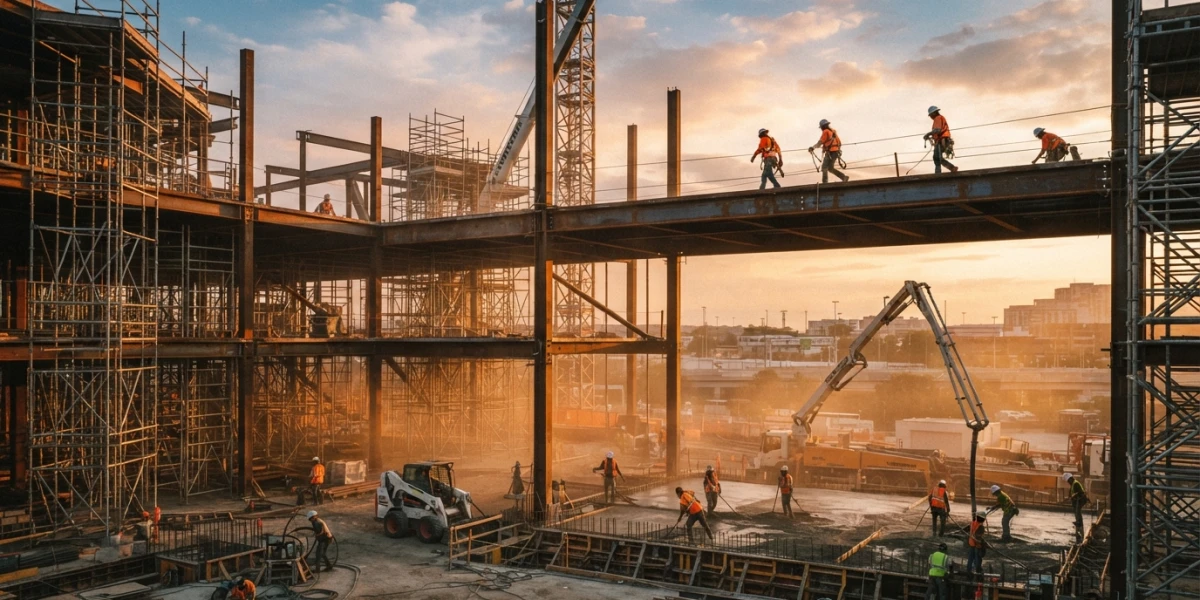
Image generated with AI
Your safety manager will zoom into the photo before your client does. One worker on an unguarded edge, one harness clipped to nothing, and the page stops selling. Construction stock photos need a different review than a product shot, and it takes about 30 seconds per image.
Why a construction photo gets audited by the people who do the work
Marketing picks the image; the site signs off on it. A superintendent reads the photo in two seconds: hard hat on or off, tied off or not, right tool or wrong tool. He is checking whether you know how the work gets done.
In a food shot a misplaced garnish is an opinion; on a job site a missing face shield is a compliance failure, and the reader trains people on that every week. If the image contradicts the safety claims below it, your credibility takes the hit.
The review has three layers: protective equipment, trade accuracy, then releases and brands.
The PPE check: read construction stock photos like a safety manager
Head protection and the fall-protection question
US rules require head protection wherever impact, falling objects or electrical shock can injure a worker (29 CFR 1926.100, ANSI Z89.1 helmets). The part buyers skip is height.
29 CFR 1926.501 applies at six feet (1.8 meters) above the next level, including edges, holes, skylights, formwork and rebar walls. A worker at the edge of a slab with no lifeline is the photo your safety team will veto. Look for harness, lanyard and a visible anchor: a harness with nothing attached is worse than none.
Falls remain the leading cause of death in construction, 389 fatal falls out of 1,034 construction deaths in 2024, per OSHA's stop-falls campaign.
Eyes, face and hands: the detail everyone crops out
29 CFR 1926.102 requires eye and face protection against flying particles, molten metal, chemicals or harmful light, with side protection when objects fly, marked to ANSI/ISEA Z87.1. In stock photos that means safety glasses, a face shield while grinding, gloves while handling material. It drew 1,965 citations in OSHA's fiscal 2025 top ten.
If the photo goes into training, the photo is the lesson
29 CFR 1926.503 requires a fall protection training program with written certification per employee, and 29 CFR 1926.21 obliges employers to teach workers to avoid unsafe conditions. Fall protection training drew 2,216 citations in fiscal 2025. Show a worker without a lanyard in a toolbox talk and you teach the opposite. For training the rule is absolute: zero visible violations in frame.
Trade accuracy: the details that make a photo read as fake
Right tool, right grip, right stage
A trowel in the wrong hand. A welder with no shield. An electrician in a live panel with no insulated gloves. Trades read trades. Name the stage first, foundation or structure or finishes, and confirm the image matches: rebar tying is not a finishing photo.
Scale, site logic and the suspiciously clean site
Real sites are messy but organized: cones, tape, material stacks, a marked walkway. Red flags: no dust, no signage, everyone looking at the camera, equipment the wrong size, scaffolding with no platforms, people under a suspended load.
AI tells in construction imagery
Generated images fail here visibly: unreadable signage, rebar fused into itself, scaffolding that leads nowhere, lanyards passing through a body, extra fingers. Inspect hands, joints and lettering at 100 percent. Our license says it plainly: the library may include AI-generated or extended content and some files carry minor imperfections, so inspection is yours. If the image is going to teach something, buy real photography; for mood and concept, generated work can serve. The wider comparison is in real photos versus AI stock.
Search strings that return real site work
Trade plus action (welder welding, carpenter framing), stage (concrete pour, formwork), equipment (excavator, scaffolding), conditions (night shift) or detail (safety harness). Skip the cliches: the handshake with a hard hat, the executives in vests with folded arms, the group posed in front of a crane.
Where construction stock photos actually earn their keep
Careers pages and job ads
In the 2025 AGC and NCCER workforce survey (1,342 responses), 88 percent of firms employing craft workers directly had hourly vacancies and 92 percent struggled to fill craft positions, most often because of unqualified candidates (57 percent) and fast quitters (48 percent). The careers page has to look like a place a professional wants to work: real trade, real crew, different projects.
Capability pages, case studies and bid documents
A coherent series, same light and same type of work, makes the portfolio read as one company. Horizontal crops for decks, verticals for project cards, and negative space over drama, as covered in hero images that convert.
Training material, internal comms and safety campaigns
Toolbox talks, site posters, inductions. No violations, and the image has to read in a badly lit room from three meters away: clear subject, no embedded text.
Ads, social and service pages
For local trades the photo is a trust signal: real house, real work, real person. Then the crop decides, 4:5 or 9:16 with the subject centered and space for the headline. See stock photos for social media ads.
Releases, logos and client property
People: model releases, uniforms and tattoos
Market reference, Shutterstock's published standards: a model release is required for commercial content showing a recognizable person, or a non-recognizable body part with a visible tattoo. On site you also inherit another company's logo on the uniform and brand stickers on the helmet. Confirm the release before you buy, not after the page is live, as explained in model and property releases.
Buildings, land and interiors: property releases
The same reference lists where a property release is needed: artwork including murals and graffiti, sculptures, restricted architectural designs on exteriors, building interiors and private land. Construction hits all of it, from the finished client job to a private site. If the image goes to a campaign, resolve it before purchase.
Logos on machines, hi-vis and signage
The brand painted on an excavator, the manufacturer logo on a helmet, the company name on a pickup. Editorial use is usually fine; a commercial campaign is a conversation to have first, as set out in commercial versus editorial licenses. If the file does not say, ask.
What our license covers
Non-exclusive, worldwide, perpetual and royalty-free, for web, social, ads, video, presentations, print up to 500,000 copies, editing and composites, client work and campaigns, with no attribution required. Prohibited: reselling the file on its own, claiming ownership, use in logos or trademarks, and illegal content. Full text on the license page.
Specs and crops before you hit download
A horizontal hero wide enough for 1920 pixels without upscaling, verticals at 4:5 and 9:16 for Reels and Stories; print math belongs to stock photos for print. Check negative space for the headline in the real crop, not the grid. Prefer neutral files, because site photos carry strong casts, the orange of machinery or the green of high visibility clothing. Check the shadows at 100 percent, because noise kills a night shot on a large screen. Formats in stock photo file formats.
What a construction image costs you
Pricing verified on the site today: one photo, one credit. Packs are 15 credits for $19, 50 for $49 and 150 for $149, used first in first out and valid for one year, and a single image on its own is $9, or roughly $0.98 to $1.27 per credit in a pack. A library of six to ten coherent images for a contractor site costs about $6 to $13 in a pack, against $54 to $90 buying them one at a time. Models compared in stock photo pricing models.
When not to use stock: your own finished project, crew and process in a prequalification package. Stock for context, brand and demand; your own photography for proof of capability.
Buy construction stock photos that survive the site review
Ten checks, thirty seconds each:
- Hard hat and eye protection match the task shown.
- If there is height, a lifeline, a complete harness and a visible anchor.
- The tool and technique are right for the trade and the stage.
- Zero visible violations if the image will be used in training.
- Site logic holds: signage, stacks, walkways, nothing flying overhead.
- Hands, joints and lettering inspected at 100 percent for AI artifacts.
- Model release for recognizable people, property release for buildings, interiors and private land.
- No readable third-party logos in a commercial campaign.
- Orientation, width and negative space fit the real destination.
- The rights you hold cover the usage you plan.
Vocabulary: PPE is personal protective equipment, a fall arrest system is harness plus lanyard plus anchor, a guardrail is passive edge protection.
A construction image gets approved twice, in the browser and on site, and the second is the one that counts. Browse the construction and industrial collection and buy the library you can reuse all year.
Related articles


Looking for the perfect stock photo?
Browse thousands of premium photos and 4K videos, pay per download.
Browse the collection