Oct 31, 2026
Stock Photos for Hotels: What to Buy and What to Avoid
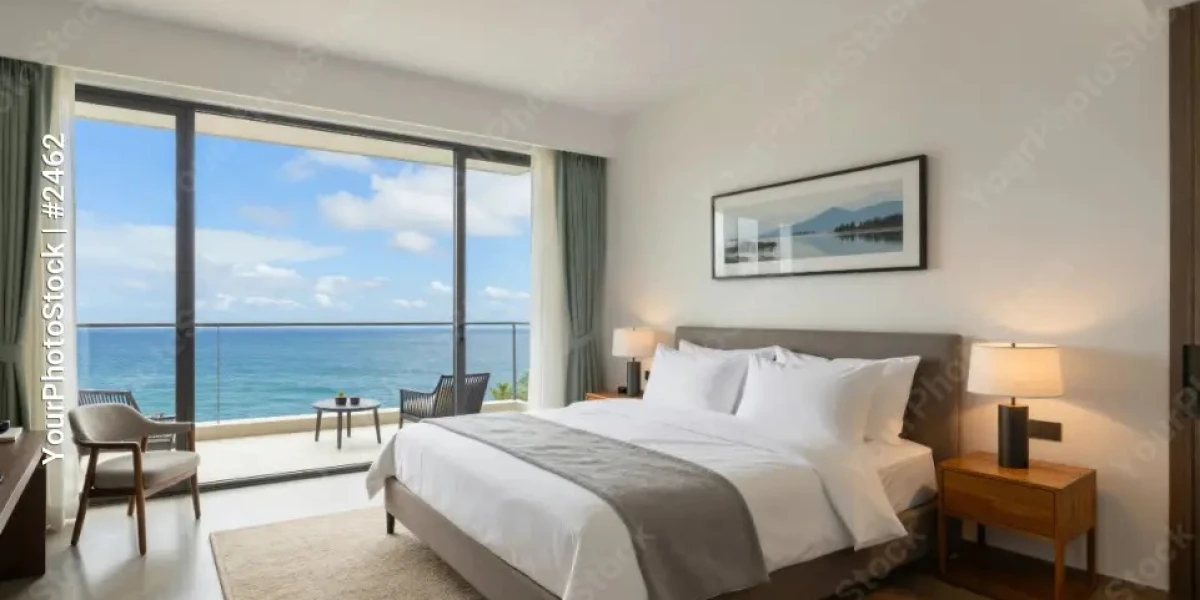
Image generated with AI
A guest decides in three seconds whether your property looks like the photos or like a stock library. Buying stock photos for hotels is not about filling a gallery. It is about knowing which slots stock can honestly fill, and which ones will cost you a booking, a review, or worse.
The gallery decides the booking before the price does
On a booking page the photo is the first filter of the funnel: long before anyone reads the room description or the cancellation policy, they have judged the property visually. A TripAdvisor study from 2014 found that the number of photos was the single factor with the biggest impact on traveler engagement: going from no photos to at least one was associated with a 138 percent lift, more than 100 photos with 151 percent, and more than 1,000 with 203 percent.
The numbers are old; the behavior is not. The lesson for a buyer is not "have photos", it is that a hotel page is made of slots, and every empty slot is a lost signal: the hero, the room, the bathroom, the neighborhood, the season, the experience, the offer. Budgeting "five pretty images" leaves half the page doing nothing. So start from the page, not from the search bar: draw the slots first, then decide which ones licensed imagery can fill and which ones need a camera on site.
The one line stock photos for hotels cannot cross: sell the destination, never the room
Accommodation platforms require that photos and descriptions accurately represent the space the guest will get. That standard is enforced by guests, by reviews, and increasingly by regulators. In October 2026 the European Commission opened an investigation into Booking.com under the Digital Services Act over fake listings and scams. That case is about fraud, not stock imagery, but it pushes the whole category one way: authenticity of the listing is under a magnifying glass.
Travelers have absorbed the message. Industry anti-scam guides routinely warn readers about listings whose photos "look like stock images". A generic lobby shot in a real listing is not a saving, it is a suspicion, and suspicion is expensive on a booking page.
The operational rule fits on a sticky note:
- Stock is fine for: destination, surroundings, season, atmosphere, experiences.
- Own photography or a commissioned shoot is mandatory for: rooms, bathrooms, facade and the specific services the guest will use.
Break that line and you are not decorating a page, you are misrepresenting inventory. If you want the licensing detail, commercial and editorial stock licenses are covered separately.
Where stock legitimately earns its place
Destination and neighborhood
The skyline, the beach, the historic center, the food street. A hotel cannot photograph what it does not own, and the guest is choosing an area as much as a room. It is the most valuable stock slot on the page, and the one where buyers settle for a generic postcard.
Lifestyle moments you do not want to stage
Breakfast being served, a towel by the pool at sunset, a glass on the terrace. Atmosphere, not inventory. Nobody expects you to prove the exact croissant is the one you serve, but the scene has to belong to the category you run.
Seasonal campaigns
Summer and winter promotions, shoulder-season escapes, local events. Bought per campaign and reused within the license for months, they are the cheapest slots per impression. Buy them in a set, not one at a time.
Experiences and tours
Kayaking, hiking, wine tasting, city tours. These fill the activities section and the blog, and are almost impossible to shoot in house without paying for the activity twice.
Editorial and B2B pages
Destination guides and "what to do in X" articles are exactly where an editorial-only image belongs. Agency proposals, MICE and wedding pages can use generic event and meeting-space imagery, as long as they do not claim a specific room the client will never see.
Check the release before you check the price
Property releases: the rule that catches hotels
A property release is the signed authorization from the owner of a building to use images of it commercially. Agencies require it when identifiable private property appears in advertising or brand content. Private interiors such as hotels, restaurants and offices almost always need one, and so does distinctive art or design inside the frame. If the release is not on file, that image is not a campaign asset, however cheap it is.
Editorial-only means no advertising
Editorial content carries no model or property releases. Alamy states it explicitly in its license details: to use editorial content commercially you need additional permissions from the property owner or from the people in the frame. An editorial asset on a booking page or in a paid ad is a licensing problem waiting to happen. And a released model can appear on your site, but never as a real guest leaving a review or as a member of your staff; that is a different claim no stock license covers.
Where to see it before paying
Look for the release flag on the asset page and use the released filter in search. Most libraries say whether a release is on file. If the field is empty, assume there is none. The model and property release guide covers the wording to expect.
The sizes and crops each channel actually needs
As working targets:
- Website hero: roughly 2400 to 3000 pixels wide to stay sharp on high-density screens, in the 16:9 or 21:9 ratio your template uses.
- OTA listing: horizontal 16:9. Crops rule here, so pick compositions with a centered subject and room at the edges.
- Social: 4:5 for feed, 9:16 for Reels and Stories. Buy once at maximum size and crop, never re-buy per format.
- Email: around 600 pixels of usable width.
- Print: 300 dpi at final size, so decide the brochure or signage size before you buy.
Exact uploader specifications change, so confirm them on the platform's current documentation before producing a batch. For the file side, which stock photo file formats to buy covers what to keep.
How to search so the result does not read as stock
Search by scene, light and context, not by aspirational adjectives. "Boutique hotel lobby morning light" returns something usable; "luxury hotel" returns the same beige render everyone else bought. Build queries as place plus time of day plus activity, and filter by orientation, people and releases from the start.
Avoid the cliches that give stock away: handshakes, high-fives, infinity pools with no context, a reception desk so perfect nothing on it looks touched. Prefer architecture with texture, and guests seen from behind or slightly out of focus when the scene does not need faces. Buy the set from one collection so light and palette do not jump from image to image. Coherence reads as credibility; a collage reads as a template.
A 20-slot set that covers a whole property page
- Exterior and arrival
- Lobby or reception
- Lobby detail (texture, flower, coffee)
- Wide room shot
- Bed and textile detail
- Bathroom
- View from the window
- Pool
- Gym or spa
- Breakfast or restaurant
- Work corner
- Destination and neighborhood, set of three
- Seasonal, set of two
- Experiences, set of two
- Atmosphere with people seen from behind
- Campaign or offer image
Mark the list before buying: room, bathroom, facade and real services are own photography; destination, season, atmosphere and experiences are stock. A set laid out this way turns an abstract budget into a shopping list.
Budget rules that keep hotels out of trouble
Buy the set once and reuse it across web, OTA, email and social within what the license allows. Pay for an extended license only when the real use demands it. Keep budget for one own shoot per year covering the five or six images that cannot be bought, because that shoot protects every stock image around it. And document each asset: ID, provider, release status, permitted uses, purchase date, so the proof survives the next agency change.
Five mistakes that cost bookings
- Putting a stock room photo in a real listing, which invites an accuracy complaint and a bad review.
- Using an editorial-only asset on the booking page or in a paid ad.
- Buying an identifiable interior without a property release for a campaign.
- Mixing ten photos from ten authors with different light and palettes, so the page reads as a collage.
- Downloading web size and discovering later that the brochure needs print resolution.
Conclusion
Stock photos for hotels cover the destination, the season and the atmosphere. The room gets photographed. Buy by slots, check the release before the price, size once for the biggest channel you will use, and you remove the risk that actually costs reservations: a page promising a property the guest does not find. Browse the collection and license the right image for each slot, one download at a time, no subscription.
This article covers commercial practice, not legal advice. Confirm licensing terms with your provider and, where relevant, with counsel.
Related articles

Looking for the perfect stock photo?
Browse thousands of premium photos and 4K videos, pay per download.
Browse the collection