Aug 7, 2026
Travel Stock Photography: How to Turn Your Trips Into a Portfolio That Sells
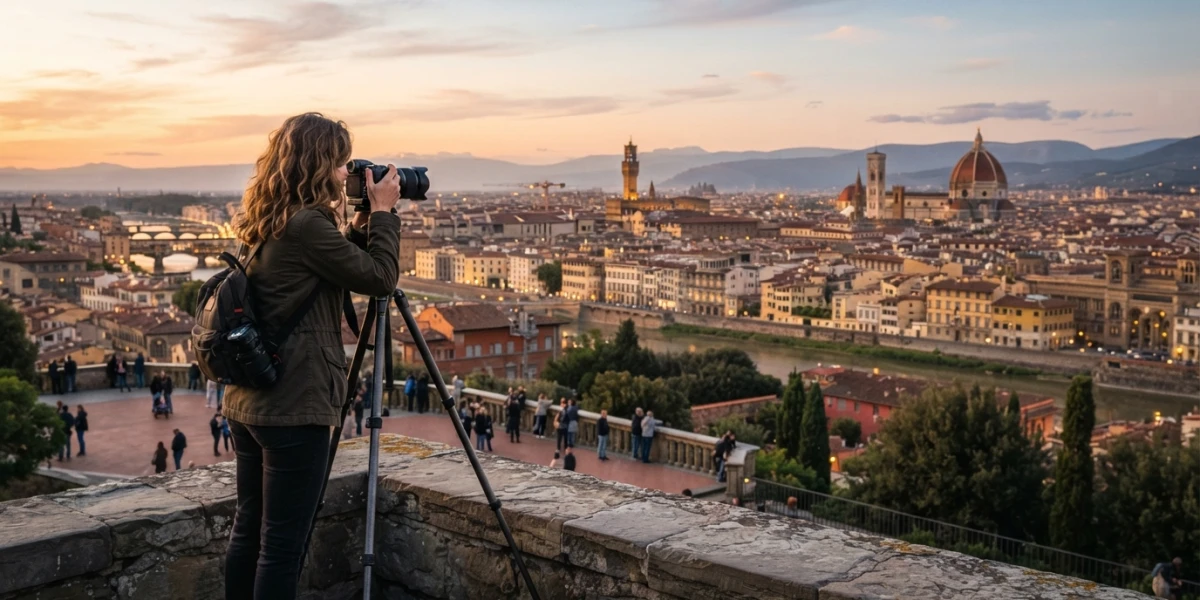
Image generated with AI
The Eiffel Tower at golden hour is one of the most photographed subjects on Earth — and one of the hardest to sell. Travel stock photography rewards the angle nobody else took, not the postcard everyone already has. Here is how to come home with images buyers actually license.
Why Most Travel Portfolios Fail
Every major destination has been shot a million times, and most of those shots look exactly alike. When a designer opens a stock library looking for Paris, they are not hoping to find another postcard of the tower from the Trocadéro; they have already seen that image a hundred times that week. The images that keep selling are the ones that give the buyer a reason to choose them: a perspective they have not seen, a detail that captures the place, a mood that matches the campaign they are building.
That is why so many travel portfolios stall. A collection of technically fine but interchangeable landmark shots has no clear subject and no obvious use, so it sits unsold for years. Technical quality is only the entry ticket. Because the competition is enormous, travel stock photography demands impeccable light and composition just to be considered — and then a point of view to be chosen. Stock agencies work as intermediaries between you and the buyer, and you earn a percentage of every license, so a portfolio that gets picked more often pays off directly.
What Buyers Search For
Buyers rarely search for a landmark name alone. They search for a place plus a scene: "Tokyo street food," "Lisbon tram," "Barcelona market," "Iceland road trip." They search by activity and by transport: a cyclist in Copenhagen, a ferry in Hong Kong harbor, a night train window. If you want your travel stock photography to surface in those searches, your keywords and your images need to match the way campaigns are actually built — a hero image for a travel ad, a header for a destination guide, a background for a booking site. Those buyers are illustrating a concept, not collecting souvenirs.
Plan the Shoot Before You Pack
The best time to research a destination is before you leave. Open a stock library and search the city you are visiting. Look at the first few pages of results and ask yourself what is missing: angles that do not exist yet, subjects that are underrepresented, light conditions nobody captured. That gap is your opportunity. Travel stock photography is planned, not improvised — the photographers who sell consistently treat a trip as a production with a shot list, not as a vacation with a camera.
Plan your timing around crowds. Early morning and blue hour give you empty streets, long light, and fewer people to work around. Fewer people in frame means more options for commercial use, because every recognizable person in your image is a potential release problem. Build a shot list for each location that covers the full range of what buyers want: a skyline, an architectural detail, local food, a transport scene, a texture, people working. Take a concrete example: a Lisbon shot list might run six frames — a tram at dawn, a wall of azulejo tiles, the produce at a morning market, a plate of bacalhau, a miradouro viewpoint without tourists, and a barista pulling espresso. Shoot every one of those vertically and horizontally.
Shoot Empty, Then Shoot With People
For every scene you set up, capture two versions: one without people and one with them. The empty version licenses cleanly for hero images, website headers, and layouts where the designer needs space to work. The version with people adds lifestyle value — a traveler reading a map, locals at a market — and sells to campaigns that need human warmth. Shooting both at each location doubles your usable output from the same hour of work, and it is the single most practical habit in travel stock photography.
The Release and Landmark Checklist
This is the commercial side of travel stock photography, and it decides whether an image can be licensed for advertising or only for editorial use. Recognizable people need a signed model release before you can sell the image for commercial campaigns. Without it, the photo is limited to editorial contexts, which dramatically narrows its market. Some landmarks and works of art carry restrictions of their own: the night lighting of certain monuments, for example, is protected, and reproducing it commercially can be problematic. Before you upload, review each image for protected elements — and when you are in doubt, prefer the shot without them so the file stays available for commercial licensing. This is exactly the kind of review your stock platform applies to the content it accepts: images that cannot be used commercially are worth less to everyone.
Details, Food, and Local Texture
The images that sell most reliably are often the ones tourists walk past. Markets, street food, hand-painted signs, tiles, tram tickets, working hands, laundry between buildings — these details are easy to shoot without releases, and they power campaigns in tourism, gastronomy, and lifestyle publishing. A close-up of a spice stall in Marrakech or a baker's hands in a Naples bakery tells the story of a place faster than another wide shot of its cathedral. Photograph the authentic local life, not the version of the city built for visitors. The insider angle is exactly what separates generic travel stock photography from images that feel true to a destination.
Composition for the Campaign Designer
Think about how your image will be used before you frame it. Campaign designers need room to work: negative space in skylines and landscapes where headlines can sit, a clear subject that survives cropping, and both vertical and horizontal versions of every scene because layouts differ. Consistency matters too. If you edit all the photos from one destination with the same treatment, buyers can use them as a series across a website, a brochure, or a social campaign — and a usable series is worth more than the sum of its parts.
Keywording and Curation
Keywords are how your images get found, and travel images need the full context: the place, the country, the activity, and the concept. "Madrid, Spain, street market, colorful produce" tells a buyer everything they need to decide. Do not pad with irrelevant tags, and do not skip the concept words — they are what match your photo to a campaign idea. Then curate with real strictness. Ten excellent images will outsell a hundred mediocre ones, and a small, consistent portfolio builds a reputation faster than a large, scattered one. Process your files to a professional standard — clean exposure, accurate color, sensible sharpening — but resist over-editing. Stock buyers prefer natural, adaptable images over heavily stylized ones they cannot match to their brand.
What to Look For as a Buyer
If you are on the purchasing side, travel stock photography has its own checklist. Confirm that the license covers the use you need — commercial campaigns require broader rights than editorial features. Avoid images with recognizable people unless the model release is confirmed, because a campaign running on an unreleased face is a legal risk you do not want. Prefer angles of the destination you have not seen a hundred times; fresh perspectives make your content stand out. Finally, check resolution and composition headroom: an image needs enough pixels for print or large screens, and enough open space for the text your design will carry.
Conclusion
Travel stock photography is not about shooting what everyone photographs — it is about photographing what everyone else missed. Plan your destinations with a shot list, shoot empty and with people, handle releases before you upload, and let details carry the story. If you are buying, look for fresh angles, clean licensing, and room for your design. Either way, your next campaign or your next trip will go further with images that have a point of view. Explore the travel collection on YourPhotoStock to see the standard — and to find the shots your next project needs.
Related articles


Looking for the perfect stock photo?
Browse thousands of premium photos and 4K videos, pay per download.
Browse the collection