Aug 6, 2026
Texture Background Stock Photos: The Quiet Niche That Sells All Year
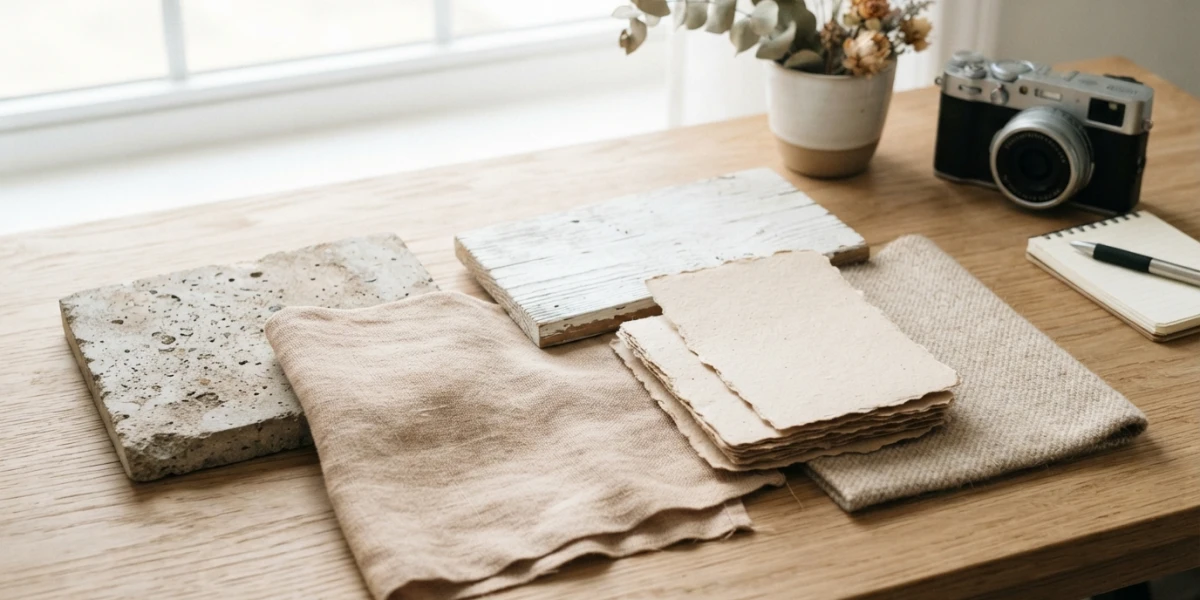
Image generated with AI
The most searched term in stock libraries is not "business team" or "happy family" — it is "background". Designers need texture background stock photos for every layout they build, and most photographers ignore the category. That is exactly why it is your easiest entry point.
Why Backgrounds Are the Most Searched Stock Category
Shutterstock's own content briefs have long reported "backgrounds" as the most popular search term in stock libraries, ahead of every people-oriented phrase you would expect. The reason is simple: backgrounds are infrastructure. Every website section, slide deck, social post, printed flyer, and video overlay needs a surface to sit on, and designers rarely shoot those surfaces themselves.
The demand is also evergreen. People-oriented stock peaks with seasons and trends, but a clean wood texture or a neutral dark background is needed in January and July alike. That consistency makes the category one of the most reliable in the industry — and one of the least crowded, because photographers prefer shooting subjects that feel more glamorous.
What Buyers Do With Textures
Understanding how textures get used explains what sells. Designers layer texture over creative assets to add depth to flat graphics, use abstract photos as backgrounds for print and online pieces, build product mockups on textured surfaces, split long pages with texture-based section dividers, and set wallpapers for apps and devices. In nearly every case, the texture is a supporting layer — which means it must be subtle enough to let content sit on top of it.
What Makes a Texture Photo Sell
Technical perfection is the price of entry. Buyers zoom in, crop, and reuse textures at large sizes, so a soft focus or noise at high ISO disqualifies a file that would otherwise be useful. Shoot at the sharpest aperture for your lens, keep exposure clean, and check edges at 100 percent before uploading.
Resolution is a selling point in itself: a file that survives aggressive cropping is worth more than a pretty one that does not. The image should carry no text, logos, or watermarks — buyers need clean canvas. Subtlety matters too: a texture that screams for attention fails as a background, because the content placed on top has to remain readable. And space matters: negative space in the composition gives designers room to position headlines and calls to action.
Where to Find and Shoot Textures
The best part of this niche is that the subjects are everywhere. Concrete, wood, marble, rust, paper, fabric, sand, and water all work, and none of them require models, releases, or expensive locations. A macro lens or a lens with close-focusing ability turns an arm's length of surface into a world of pattern.
Lighting decides the mood. Raking side light skims across a surface and reveals its relief — the grain of wood, the weave of fabric, the texture of stucco — which is what makes a texture read as three-dimensional. Overcast light, by contrast, produces even tones with no hotspots, which is what you want when the buyer will place text on top. Shoot the same surface in both conditions and you get two different products.
Try this mini-guide on three everyday surfaces. For wood, use side light at a low angle to bring out the grain, and shoot at f/8 or tighter for edge-to-edge sharpness. For crumpled paper, use soft window light and a slightly higher angle so the folds catch gentle highlights without blowing out. For concrete, wait for overcast light to keep the tone uniform, and include a small section of the surface rather than an endless sweep — the texture reads better with a sense of scale.
Abstract and Macro Approaches
Beyond straight documentation, camera techniques generate textures nobody else has. Intentional camera movement sweeps light and color into painterly streaks, zoom bursts pull the eye toward a central point, and light painting writes unique patterns across dark surfaces. Abstract work of this kind sells well because it is impossible to reproduce exactly, which keeps it scarce in a category built on volume.
Contrast is the compositional trick that lifts texture work: pairing smooth with rough, organic with geometric, or matte with glossy creates tension and depth. A single texture photographed flat is a swatch; two textures in dialogue are an image.
Seamless and Tileable: The Designer's Secret
The files that command the highest value are seamless. A pattern that tiles without visible seams lets designers fill any area, from a button to a billboard, and that flexibility is worth paying for. To make tiling possible, shoot with flat, even light and keep the camera perpendicular to the surface — angle introduces shading that breaks the pattern at the edges.
Consistent color palettes matter as much as geometry. A buyer working on a brand identity needs backgrounds that match its palette, so a series of textures in coordinated tones — warm neutrals, cool grays, muted earths — is more useful than a random rainbow of files. Shoot in series with a consistent style and the collection becomes a resource, not a pile.
Keywording and Curation
Keywords decide whether a good file ever gets seen. Cover the material, the color, the mood, and the use: "wood texture", "dark background", "watercolor paper", "seamless pattern". Buyers search by color and surface type far more than by artistic intent, so lead with what the texture literally is, then add the mood words.
This is where curation mirrors what a well-organized library does on the buyer's side. A collection that groups textures by color and material, with consistent naming and reliable keywords, is what lets a designer land on the right background in two searches instead of twenty. Volume plus consistency is the winning formula in this niche: more files, in coherent series, correctly tagged, beat a handful of brilliant orphans.
Conclusion
Texture background stock photos are the quiet workhorse of the stock industry — the most searched, the least seasonal, and one of the few categories where a photographer with no models and no studio can build a real portfolio. Shoot sharp, keep it subtle, make it tileable, and keyword it like a designer would search. The buyers are already looking.
If you sell, start tomorrow: photograph one surface three ways — close, wide, and with raking light — and see which version earns its place. If you buy, explore the YourPhotoStock texture and background collection and notice how much easier a project gets when the right surface is one search away.
Related articles



Looking for the perfect stock photo?
Browse thousands of premium photos and 4K videos, pay per download.
Browse the collection