Aug 9, 2026
Aerial Stock Photography: Selling Drone Photos Agencies Want
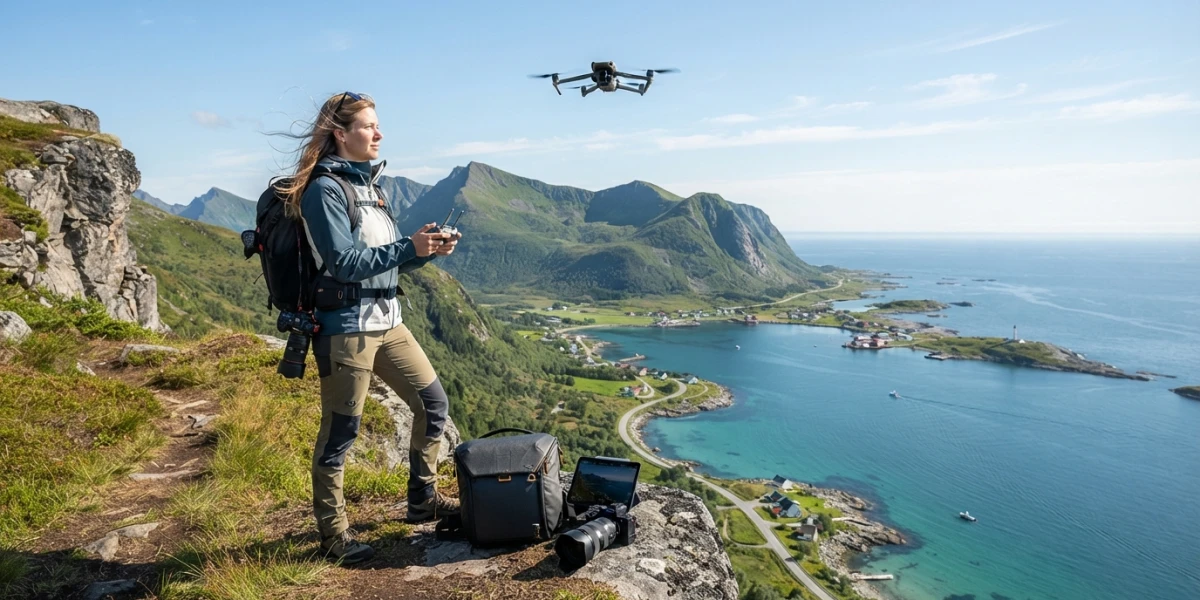
Image generated with AI
Aerial photography used to mean a helicopter charter. Today a modest drone and a Part 107 certificate put the sky in reach, and real estate, construction, and tourism marketing pay for the view. Here is how to turn flight time into license-ready aerial stock.
Why Aerial Images Sell
The aerial view delivers something no ground-level frame can: scale and context. A single photograph can show a resort against its coastline, a development plot relative to the highway, or a campus arranged around its green spaces. That is exactly the information buyers in commercial real estate, hospitality, construction, and institutional marketing need when they evaluate a property, and it is why they routinely pay more for a good aerial than for a standard exterior shot.
Demand has grown enough to support agencies dedicated exclusively to aerial content. Amazing Aerial, for example, works with more than 700 creators across over 110 countries and licenses footage to clients such as National Geographic and Microsoft. Getty Images alone hosts more than 670,000 drone photographs in its catalog. The category is not a niche experiment; it is an established, well-funded segment of the stock market, and the legal barrier to entry keeps the supply side far less crowded than ordinary landscape photography.
The Legal Baseline (US)
In the United States, commercial drone work falls under the FAA's Part 107 rules, and getting compliant is a three-step process. First, study the regulations in 14 CFR Part 107. Second, pass the aeronautical knowledge exam to earn your Remote Pilot Certificate. Third, register your drone with the FAA, which is mandatory for any aircraft that weighs 250 grams (about 0.55 pounds) or more.
The rules have loosened in one important way: since April 21, 2021, Part 107 pilots can operate at night, over people, and over moving vehicles without a waiver, provided they meet the specific requirements of that rule, such as having the right lighting and anti-collision features. What has not changed is controlled airspace. Flying below 400 feet inside controlled airspace still requires an authorization from air traffic control, including for night operations. Aircraft under 55 pounds can be flown for business purposes under Part 107, which covers almost every consumer and prosumer drone on the market.
Remember that the FAA rules are specific to the United States. Every country has its own aviation authority and its own restrictions on commercial drone flight, so verify the local regulations before you fly, wherever you are.
Releases and Privacy
You do not need a property or model release for a pure landscape, even shot from the air. The moment people are recognizable in the frame, or a private property is clearly identifiable, agencies may require releases, and some will reject the image outright. Beyond releases, respect privacy and obey temporary flight restrictions; a great angle is not worth a fine or a lost portfolio.
Gear: Sensor Size Is the Spec
When photographers ask which drone to buy for stock work, the price is the wrong starting point. The specification that decides whether your images will license is the sensor. A larger sensor gives you more dynamic range and cleaner low-light performance, which matters enormously when you are lifting shadows in post or shooting into the golden hour.
The sub-250-gram class, like the DJI Mini 4 Pro with its 1/1.3-inch sensor and f/1.7 lens, is an appealing entry point: it avoids FAA registration for recreational use, flies almost anywhere, and produces surprisingly clean files. For commercial and real estate work, however, most working pilots step up to a 4/3-inch sensor, such as the one in the DJI Mavic 3 Classic, for the extra latitude and sharpness. Avoid the low-end 1/2.3-inch sensors found in older budget drones; they fall apart with noise the moment you push the shadows, and stock reviewers will notice.
Aerial Composition: The Rules Change at Altitude
Composition from the air is a different discipline. The patterns that make a great aerial image, field lines, road curves, the geometry of a marina, the long shadows of late sun, are invisible from the ground. Train your eye to look for them: use roads and architecture as leading lines, watch how crops and water create texture, and include a human element, a car, a boat, a person, whenever you can, because scale is what makes a viewer understand the height.
Shoot in RAW and time your flights for the golden hour. Aerial images are heavily edited, and the extra dynamic range of RAW gives you the latitude that a JPEG from a small sensor simply cannot survive. A clean, sharp, well-exposed file is the baseline; everything else is negotiable.
The Real Estate Add-On
For photographers already shooting interiors and exteriors, the drone is the add-on that pays for itself. Aerial views of a property and its surroundings are routinely sold as premium upgrades in real estate listings, and they are the easiest upsell in the business because the buyer already trusts you and already needs the shot.
From Takeoff to Upload: A Six-Step Workflow
If you are new to aerial stock, this sequence keeps you legal and productive: first, verify the local regulations and any airspace authorizations for your location; second, choose a drone with a sensor that matches the work, at least 1-inch class for anything commercial; third, fly during the golden hour when light and shadows give the terrain depth; fourth, compose around lines, patterns, and human scale; fifth, shoot RAW with conservative exposure settings; and sixth, review sharpness on a large screen, then upload with strong aerial keywords such as "aerial view," "drone photography," and the specific subject of the shot.
What Buyers Expect From Aerial Stock
Buyers licensing aerial images have a short checklist. Resolution must survive large-format use, so deliver the full sensor output, never an upscaled frame. Horizons and verticals must be clean, especially with buildings in the frame. Motion blur is an automatic rejection, which means shutter discipline matters more than in ground photography. And the license must be unambiguous: editorial when recognizable landmarks or people appear, commercial when the image will sell something. A curated collection that has already been reviewed for these details saves buyers real time, which is the value proposition of a vetted library like YourPhotoStock.
Conclusion
Aerial stock photography rewards preparation. The legal barrier keeps the field less crowded, the sensor decision determines your ceiling, and composition from altitude is a skill you can build on every flight. If you fly, stay compliant, choose your gear by sensor, and shoot with the crop and the license in mind. If you buy, look for sharp, high-resolution aerial images with clear licensing, and browse the YourPhotoStock collection to find aerial shots that are ready for commercial use.
Related articles



Looking for the perfect stock photo?
Browse thousands of premium photos and 4K videos, pay per download.
Browse the collection